The AI-discovery fields
Every post read by AI discovery carries two fields that classify it, plus a set that extracts what's actually in it — seven on a video, six on a carousel.
Huntit's own reads render in the client's language. The two classification values stay English, and quoted text stays exactly as it was said or shown — see Huntit and your language.
A — in any extracted field is an honest empty — it means there was nothing to pull (a music-only video has no hook or transcript). It never means zero and never means broken.
A video over the 5-minute AI-analysis limit has no fields at all — the AI was never asked to read it. That is a different thing from an empty field; see AI discovery.
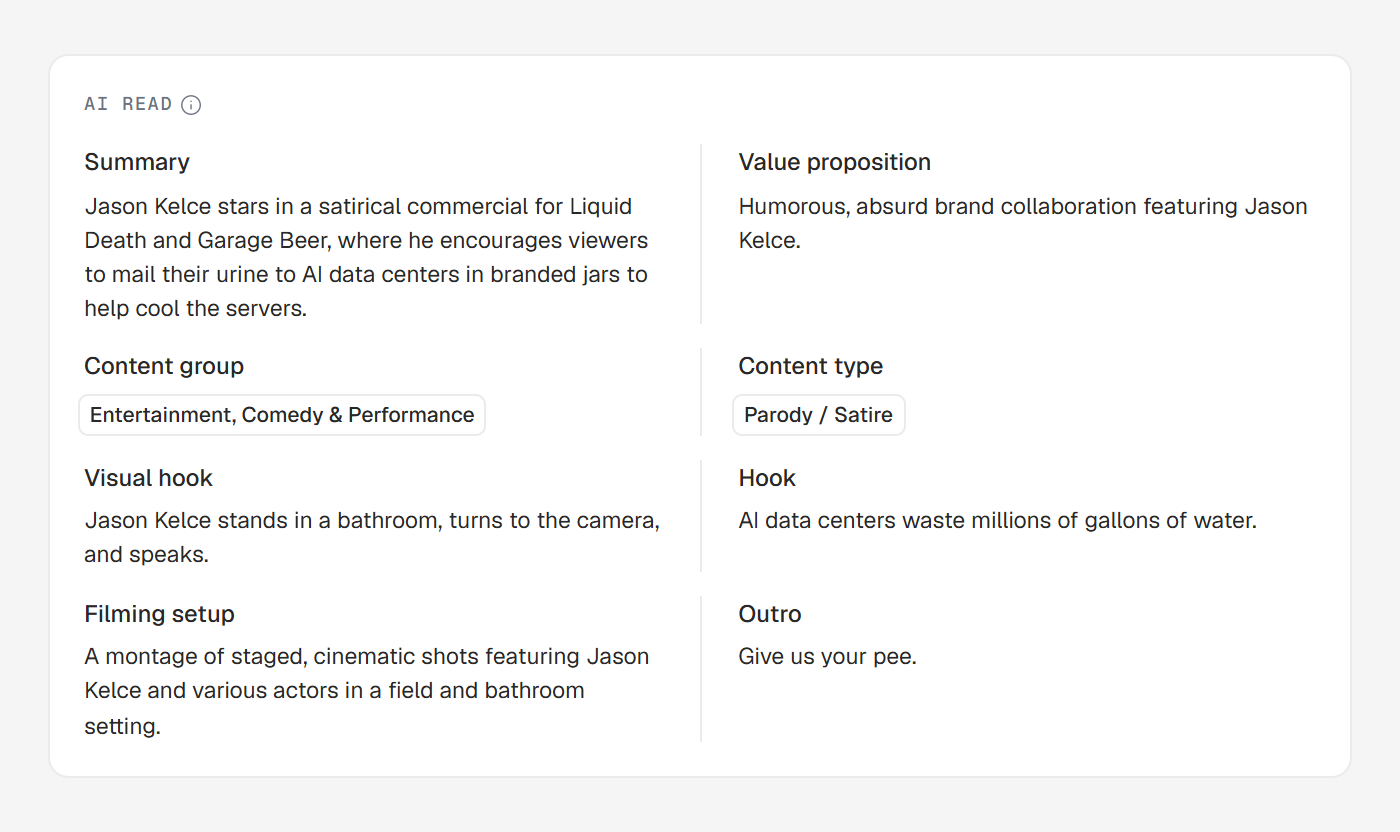
The two classification fields
Each field gets exactly one label. A post is never tagged with a combination, even when it mixes intents — the classifier picks the single dominant reading.
- Content group — the post's dominant viewer intent: why someone watches.
- Content type — the structural format underneath it (Tutorial, Quick tips, Storytime, Reaction, Tier list and the like): how the post is built.
Type is format-scoped, so a type that only exists as video — a duet, a reaction, a time-lapse — is never assigned to a carousel.
Both labels power the filters and gallery views in your feed, so you can pull every Educational & Practical post across a client at once.
The AI assigns them and they can't be edited by hand. If one reads slightly off on a particular post, that's the classifier picking the single dominant reading — you can always judge the post yourself from the media and the summary.
The eight content groups
These are the eight macro-intents, and they are the full, fixed names used across Huntit:
- Educational & Practical — teaches, clarifies, explains, or demonstrates. The viewer learns something or sees how something is done.
- Analysis, Opinions & News — breakdowns, takes, commentary, reactions to events. The viewer gets interpretation or a stance.
- Storytelling & Narrative — story-first content that holds attention through plot, emotion, and character. The viewer follows a story.
- Entertainment, Comedy & Performance — humour, skits, challenges, trends, music, dance. Fun is the product.
- Personal & Lifestyle — daily life, vlogs, behind-the-scenes, updates. The viewer connects with a person.
- Interaction & Social — Q&A, polls, replies, duets, community prompts. The viewer participates or is directly addressed.
- Products, Offers & Recommendations — reviews, hauls, unboxings, launches, promotions. The viewer evaluates, discovers, or is sold to.
- Aesthetic, Sensory & Mood — visual satisfaction, ASMR, textures, atmospheric scenes. The viewer experiences rather than learns.
The eight are mutually exclusive — one dominant intent per post. A post that is 60% tutorial and 40% storytelling is filed as Educational & Practical.
The extracted fields
- Summary — what happens or what is presented, in neutral factual terms (up to ~240 characters). It opens with the post's own subject, so a column of summaries from one profile reads as a list of topics rather than one repeated sentence.
- Value proposition — the primary reason someone would watch: the payoff. That's the contrast to hold onto. The summary says what the post does; the value proposition says why anyone would care.
- Visual hook — what the viewer sees in the first two or three seconds, or on the first slide: the opening image, not the opening words.
- Filming setup — how the post was shot, from what is visible: the setup (one continuous take, montage, screen recording, split-screen, static graphics), the setting, then who appears. It answers the question Content type hides — could my client reproduce this? A Tool / Product Demo is a screencast or a person talking under the same label. Videos only: a carousel's slides are already in front of you, so the row is absent rather than dashed.
- Hook — the first one or two spoken sentences of a video, or the dominant text of a carousel's first slide. The words that open the post.
- Outro — the closing line or call-to-action: the last spoken words of a video, or the last slide's text.
- Transcript — the full spoken words plus on-screen text for a video, or the slide-by-slide text for a carousel.