Comments intelligence — the 5 audience layers
Comments intelligence reads a post's comment section and returns five layers of audience insight.
You press Analyze comments on a post, pick how many comments to read, and after a minute or two the modal swaps to a reader with the five layers.
Where the intelligence brief tells you why a post works, this tells you what its audience is actually saying — the raw material for what to say back.
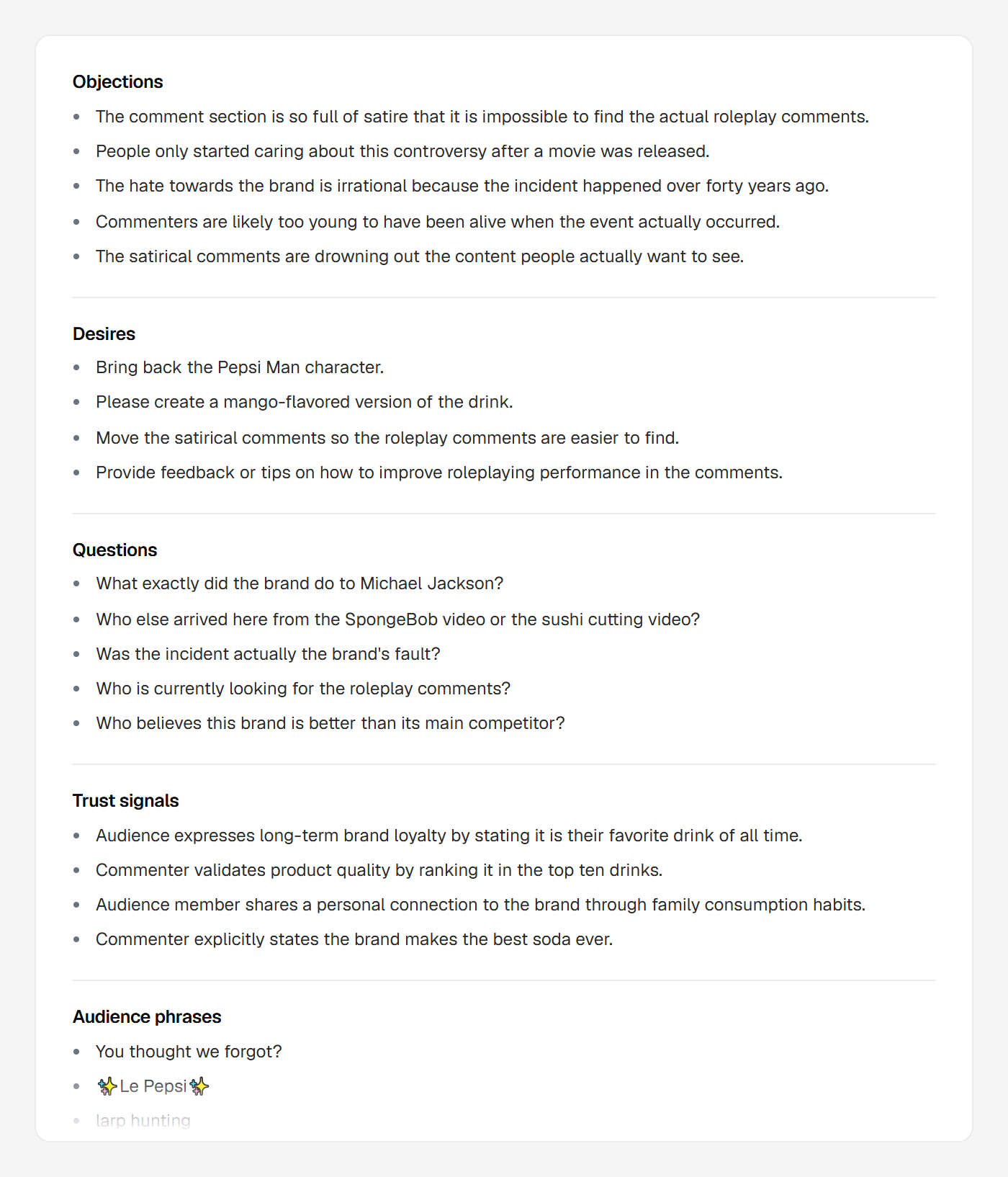
The five layers
- Objections — pain points, pushback, confusion, disagreement, criticism. Harsh-but-real criticism counts; only content-unrelated attacks are filtered out.
- Desires — wants, requests, wishes. Phrased as a wish or an imperative: "wants a vegan version," "asks for a part 2." A desire wants an action.
- Questions — genuine information-seeking questions where an answer would make sense. A question wants an answer. A rhetorical "who else wants more of these?" is a desire, not a question.
- Trust signals — explicit statements of credibility or legitimacy from the audience: "been following for five years," "I tried this and it worked," "not a scam."
- Audience phrases — verbatim snippets of how the audience actually talks, lifted exactly. These stay in the commenter's original language (with a translation added when it differs from your AI language) — the raw voice, untranslated by design.
The first four layers are written in your agency's AI language. The reader also carries the full raw scraped comments underneath, for transparency — the analysis and the source it was drawn from, side by side.
"No usable comments" is not a failure
Sometimes the reader shows a calm card instead of five layers:
"No usable comments yet. The scrape worked, but the comment section didn't have enough to analyze — too few real comments, or all spam. The post may get usable comments later."
That's an honest result, not an error. Because nothing was analyzed, the run doesn't count toward your monthly usage — and if the post gathers real comments later, you can run it again then.
A post with no comments at all, or one whose comments can't be read publicly, lands on a failure card instead — see when an analysis fails.